

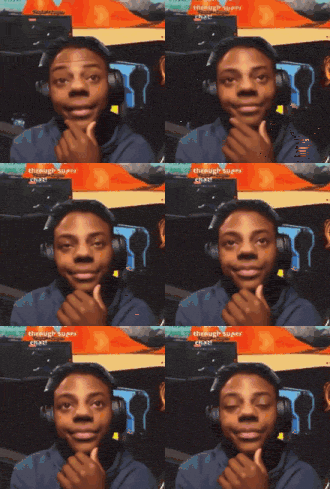
Some sound effects exist purely to fill in a reaction the audience is already having before they've had time to say it out loud. The 'oh no' sound effect is one of the clearest examples — a short, quiet, almost resigned little sting that drops in the instant something goes mildly, obviously wrong.
It isn't a scream, a siren, or a dramatic sting. That restraint is exactly what makes it useful: it's built for small stakes, not big ones.
What makes this sound effect work
The 'oh no' sound effect works because of what it doesn't do. It doesn't escalate the moment into something bigger than it actually is, and it doesn't ask the viewer to feel real concern. Instead, it acknowledges a small stumble with just enough weight to be funny — the audio equivalent of a raised eyebrow rather than a gasp.
That subtlety is also what separates it from louder alternatives. A glass breaking sound effect or an alarm-style sting announces that something dramatic just happened. The 'oh no' sound does the opposite — it tells the viewer this is small, this is funny, and everyone involved is going to be fine.
The pause that makes it land
Most effective uses leave a tiny beat of silence right before the sound plays, letting the mistake register visually for a fraction of a second before the audio confirms it. Playing the sound too early, on top of the mistake itself, tends to undercut the joke instead of landing it.
Best moments to drop it in
This sound effect is most at home in situations where someone is clearly, harmlessly wrong: a dropped prop mid-sentence, an answer that's immediately corrected, a plan that falls apart in an obviously minor way.  A small dog wearing a graduation cap and gown holds a diploma — view on SoundGIFs It also works well stacked right before a bigger punchline, functioning as a setup beat rather than the joke itself.
Gaming and stream clips
In gaming content specifically, it fits missed jumps, wrong turns, or a slightly bad call that isn't quite big enough to deserve a full gaming fail sound effect. The scale of the sound should roughly match the scale of the mistake — using it for something genuinely disastrous tends to undersell the moment.
Everyday reaction content
Outside of gaming, this sound slots naturally into everyday reaction clips — someone forgetting a name mid-introduction, a joke that doesn't land, a typo read out loud. It's a quiet way of saying "that happened" without breaking the flow of the video to comment on it.
Common mistakes editors make with it
The most common misstep is overusing it. Because the sound is subtle, it's tempting to drop it in every time anything mildly awkward happens, which flattens its impact fast. Saving it for moments that actually deserve a small acknowledgment keeps the sound funny instead of background noise.
The second common mistake is pairing it with a moment that's too big. If the mistake is genuinely dramatic or surprising, a quieter alternative undersells it — that's a job better suited to something with more weight behind it.
Building it into a soundboard
For anyone assembling a personal or discord soundboard setup, this sound works best as one option among several reaction-scale stings rather than a single catch-all for every mistake. Having two or three sounds of slightly different intensity — one for tiny stumbles, one for medium ones — gives more room to actually match the reaction to what just happened on screen.
Conclusion
The 'oh no' sound effect earns its place in a soundboard by staying small. It's not competing with sirens or screams — it's filling the quieter gap of "that was a little bit of a mess," which turns out to be one of the most common reactions any video needs. Browse SoundGIFs' library of reaction sound effects to find the right intensity for your next edit.