

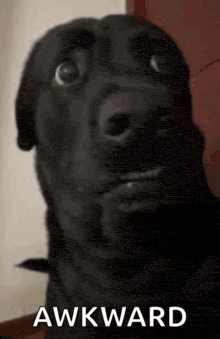
Some moments in a conversation don't call for a real response — they call for an acknowledgment that everyone in the chat just felt the exact same flicker of discomfort at once. That's the specific gap a nervous laugh GIF fills.
Unlike a full laughing reaction, which signals genuine amusement, a nervous laugh sits somewhere between funny and uncomfortable. It's the visual version of an exhale through a half-smile, and it tends to defuse a moment far better than silence or an overly serious reply would.
What separates it from a normal laughing reaction
A regular laughing GIF says "that was funny." A nervous laugh GIF says "that was funny, and also I don't quite know what to do with that."  Rue Mc Clanahan Nervous Laughter — view on SoundGIFs That second layer is what makes it useful specifically for moments that are a little too honest, a little too blunt, or just slightly cringeworthy.
Why it works better than saying nothing
Silence after an awkward comment tends to make the moment feel bigger than it is, since nobody in the chat knows whether it landed or not. A nervous laugh reaction closes that gap immediately — it confirms the moment was noticed, treats it lightly, and gives the conversation permission to move on.
Best situations for a nervous laugh gif
This reaction shines in a specific, recognizable category of moment: a joke that gets a little too real, an overshare that nobody asked for, or a comment that's funny specifically because it's slightly too honest. It also works well after someone points out an obvious mistake in a way that's more true than anyone wanted to admit.
Group chats vs one-on-one chats
In a group chat, a nervous laugh reaction works as a kind of shared signal — multiple people can send it, and it reads as the whole group feeling the same way at once. In a one-on-one chat, it's a gentler way of acknowledging an awkward comment than either ignoring it or addressing it directly, without escalating the moment into an actual conversation about it.
When to avoid it
If the comment that triggered the awkward beat was actually hurtful rather than just cringey, a nervous laugh reaction can come across as dismissive. This reaction is built for lighthearted discomfort — bad jokes, oversharing, mild cringe — not for genuinely upsetting moments, which deserve an actual response instead of a GIF.
Pairing it with other reactions
A nervous laugh often works well as a first response, followed a beat later by something warmer if the moment calls for it — a deep sigh gif to signal exasperation, or a straightforward laughing GIF once the initial awkwardness has actually passed and the joke starts to feel funny rather than uncomfortable. Using it as the opening reaction rather than the only one tends to read as more natural.
Conclusion
A nervous laugh GIF works because it doesn't force a moment to be more or less than it is — it just acknowledges the shared discomfort and lets the conversation keep moving. Browse SoundGIFs' collection of reaction GIFs for every mood to find the right level of awkward for your next group chat moment.